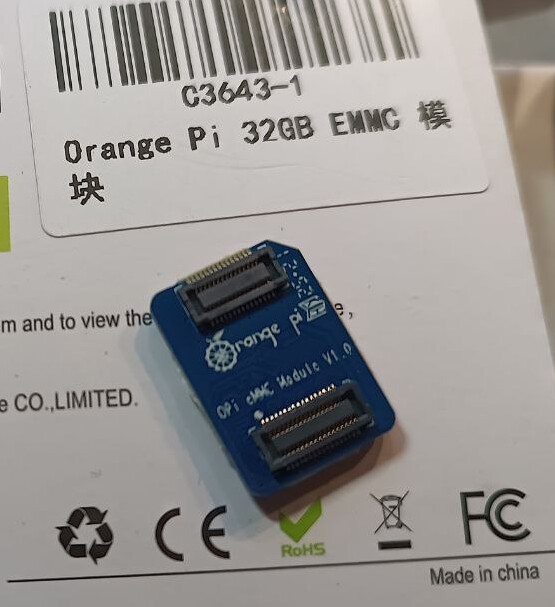
I recently purchased this board, and after almost a month of use, I’ve decided I’ll need eMMC. The board’s documentation doesn’t provide any information about which modules the eMMC connector supports. I found v1.0 for Orange Pi and v1.2 for Radxa boards on AliExpress. So, which modules does this board actually support?
1 Like
Radxa’s the only I can say with certainty to work on the Jupiter.
I originally bought NVMe memory for my M.2 slot, but I realized there’s no USB-C headers anywhere for front panel ports, and that forced me to use eMMC memory so I can slot an M.2 USB-C header adapter in my M.2 slot.
Jupiter’s an overall great board, extremely scalable, but there’s some minor hiccups in the design, and I’ve made a post on these forums asking Milk-V to address some of these issues for the next possible (rumor mill at the moment) Jupiter board running the SpacemiT K3.
2 Likes
Thanks for the clarification about the eMMC modules, Radha.
As far as I understand, version 1.2 is for the 128GB and 256GB models, and version 1.1 is for the 16MB/32GB/64GB models. Or am I mistaken?
1 Like
I can’t say with certainty for the version differences, but I know for sure Radxa’s 128GB memory works, or at least with my setup since I’m working on a custom Rust OS, momentarily named “JupiterOS” in public forums.
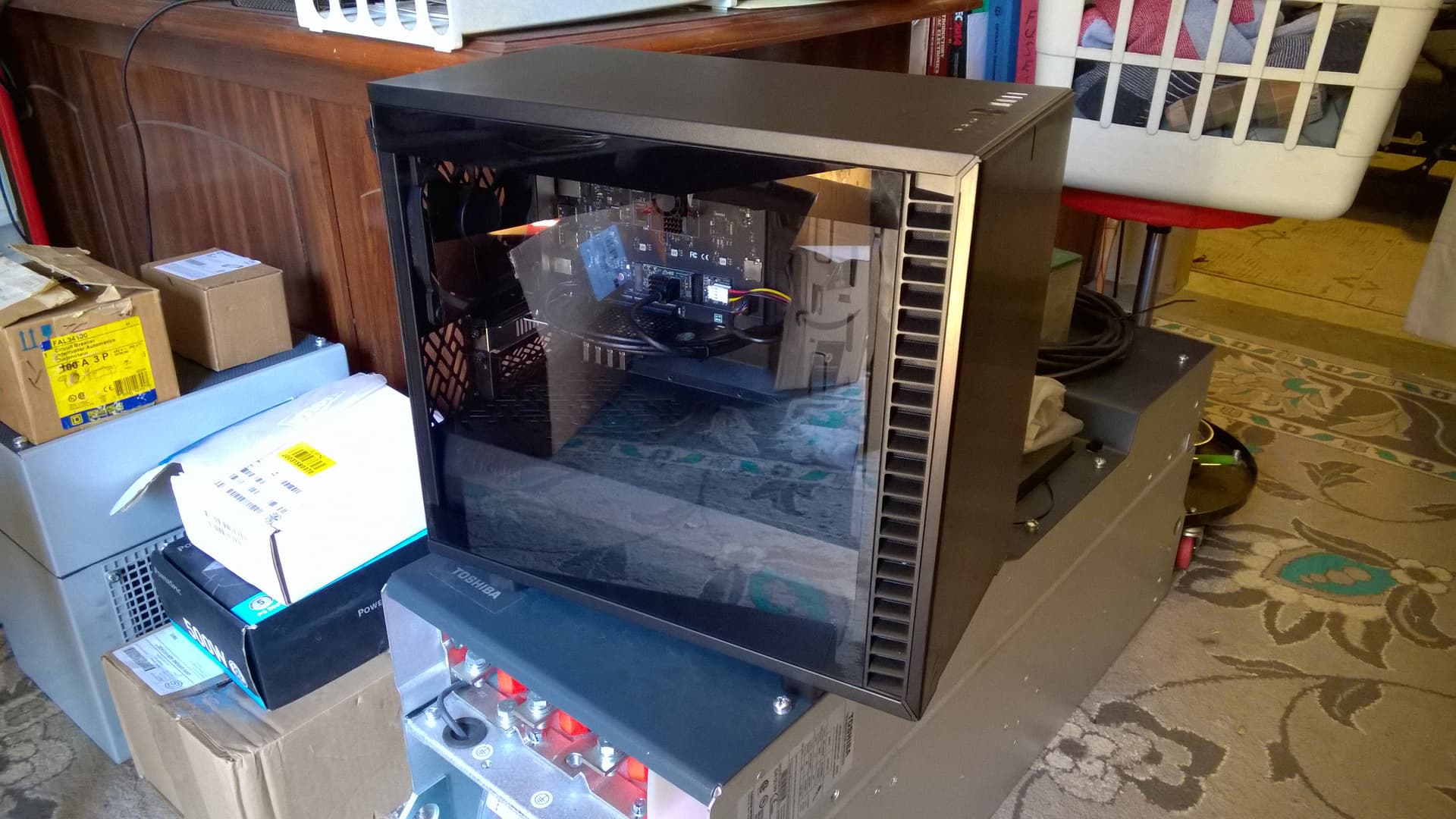
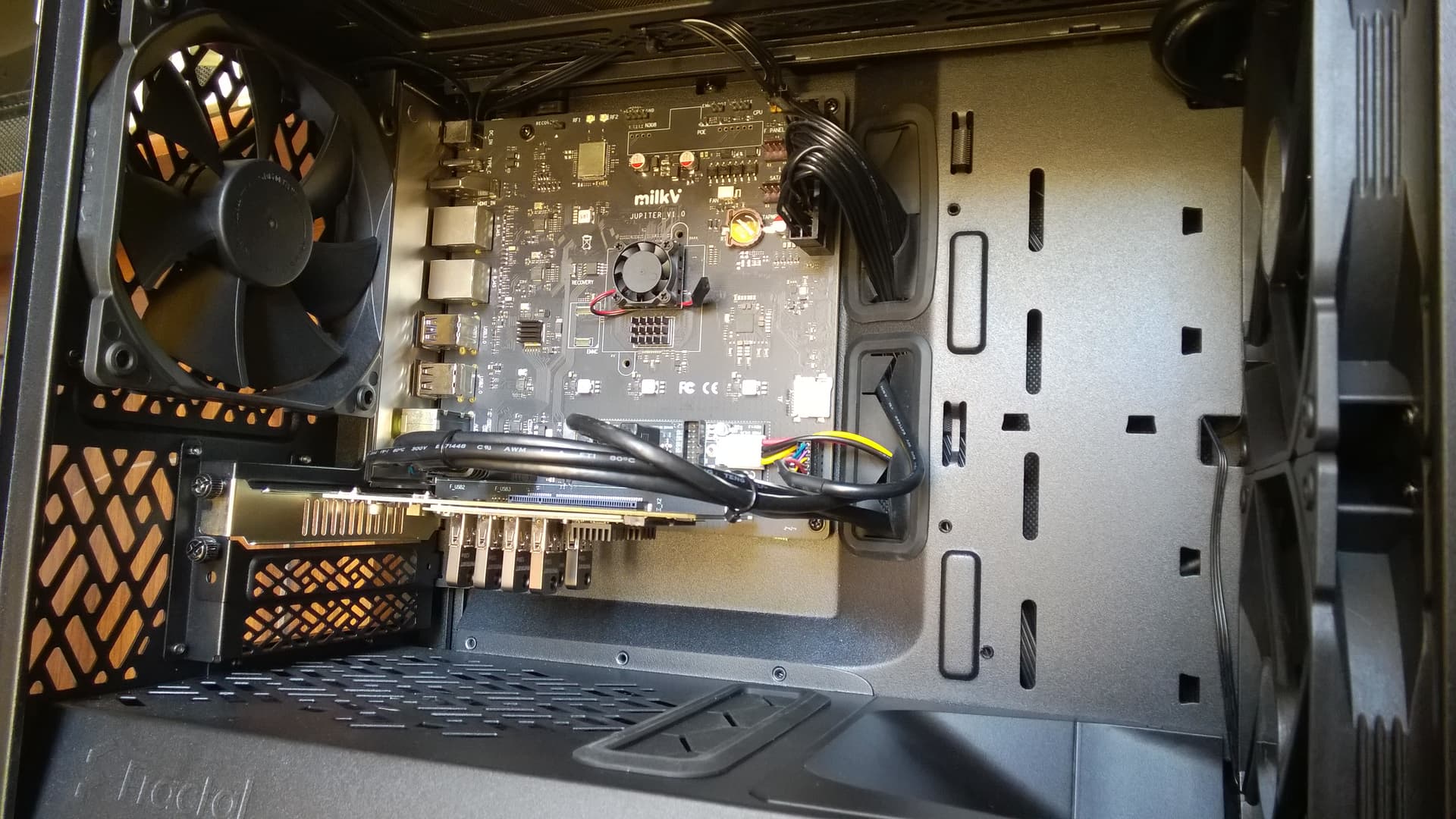
I’m still looking for a large, passively cooled heat sink since my case fans are plugged directly into the power supply thus, my case fans are running full speed at all times because there’s no header to modulate them on the Jupiter, but here’s a photo of my tower as of inserting the M.2 USB-C adapter—I’d like to see Milk-V make a new Jupiter board in the same vain as HiFive Premier P550, but with the scalability of the Jupiter, and correcting some of these minor “inconvenient” issues.
2 Likes
I have a similar problem. My processor currently has absolutely nothing installed; I couldn’t find anything suitable. It’s cooled only by a 120mm cooler connected to a Molex connector. I manually unlock the processor overclock to 1800 MHz. And I strictly control the temperature during compilation. For example, when compiling systemd, I have to manually limit the number of cores used. But even under maximum load on all 8 cores, the temperature did not exceed 65 degrees Celsius.
I suspect this board requires a heatsink from a video card. The connector looks awfully similar to the one found on older VGA cards.
2 Likes
SpacemiT’s K1/M1 has been documented for 2,000MHz, but they’ve only ever released the processor with 1,600 & 1,800MHz, and I’ve never dabbled with overclocking yet as I’ve primarily focused on optimized efficiency for K1 & M1 since K3’s coming this year at the earliest.
Have you been able to achieve 2,000MHz under stable temperatures and loads?
I suspect this board requires a heatsink from a video card. The connector looks awfully similar to the one found on older VGA cards.
I’ve had somebody tell me the same thing in my first post here: some form of older 40x40mm video card heat sinks, but I can’t find any from any generic product page, and I’ve just ordered these heat sinks this week for testing on the Jupiter: Aluminum Heatsink - 45x42x28mm
1 Like
No, I haven’t tried overclocking beyond 1800 yet. I wouldn’t do that without reliable cooling.
Looks good enough. I just hope it fits the mounting holes.
1 Like
I’ll post updated photos if the heat sinks clear all parts and whatever hardware changes I do next when I pull my Jupiter out of the case.
2 Likes
No go on those heatsinks.
They’re perfect in every respect, cleared all parts, but the mounts are on opposite sides from the Jupiter’s outlined holes.
Found Hardkernel’s got a heatsink that’ll fit, but those heatsinks are an anodized blue rather than a powdercoat black (my preference) if that makes a difference for you.
This is not good.
Yes, the blue color doesn’t really match the board’s color scheme.
But on the other hand, the heatsink’s design allows for a fan to be installed, I think.
On the other hand, is it worth the effort to complete a build for the Jupiter board now, given the announcement of the Jupiter 2 board and Jupiter 2 dev kit?
I must’ve missed the news for the new Jupiter, but there’s been a lot of subtle hints and pinch of salt leaks since SpacemiT announced the X100, and officially released the K3.
You got a link to the announcement?
“On the other hand, is it worth the effort to complete a build for the Jupiter board now,”
I’ll still continue working on the Jupiter since JupiterOS already has a full development profile for it and I’ve already got partial implementation for the K3.
No, I didn’t see the boards announced. They just added them to the hardware list without any announcement Here Milk-V Jupiter2 | Your All-in-One Development Platform and here Milk-V Jupiter2 Dev Kit | Everything You Need in One Kit
I tried looking at the processor announcement on bilibili, but I didn’t understand anything.
Well, these boards aren’t available for sale yet. You can only buy a discount coupon. There’s no word yet on when they’ll be available. I don’t plan on buying anything else before the end of the year, except for eMMC or NVMe drives for the Jupiter board.
1 Like
Ninety percent of bilibili’s video’s already on Milk-V’s Jupiter2 page for anything relevant to us.
I seen him talking about a 16-core K3 if I understood him correctly, but Milk-V’s already given us the official specs for Jupiter2 with an 8-core processor so, that could be for another board elsewhere.
I didn’t see a release date for Jupiter2, but did see Jupiter2’s not a mini-ITX board, not quite pico-ITX either though mounting holes could be pico-, but Jupiter2’s using an odd dimension and layout than I was expecting…. However, Jupiter2 with the Radxa carrier board looks standard all the way around based on what’s visible, and that dev kit may become my next board since it should be backward compatible with Jupiter NX as well though I’m still waiting for the Cluster-08 to get a release.
Cluster-08 is a good idea. But…what I saw here is that there are eight NX boards, and they’ll all need to be cooled somehow. Such a board would need to be installed in a well-cooled case, and at the same time, there would need to be access to it, at least to the Recover button.
Yes, I was also interested in this board.